
The Digital Cash Layer for Stablecoins

Introduction
Stablecoins have emerged as the preferred medium of exchange for digital commerce. Their price stability makes them ideal for payments, accounting, and automated financial operations, while decentralized networks provide the openness and programmability required by modern applications. As agentic commerce grows, the combination of stablecoins and decentralized payment infrastructure will become increasingly important.
Bit2 was designed from the ground up to provide a high-performance payment layer for both humans and autonomous agents. By combining client-side validation, privacy-preserving cryptography, and compliance-friendly tools, Bit2 enables stablecoin payments that are fast, scalable, and suitable for global commerce.
Bit2 allows agents and users to transact in stablecoins, and we are committed to making regulated stablecoins available on Bit2 at launch. While agents generally prefer to transact over decentralized networks, they also show a strong preference for stablecoins over native cryptocurrencies such as Bitcoin. A recent research report on popular LLMs estimates that, when given a choice, nearly 53% of agentic commerce would be conducted using USD-denominated stablecoins, while Bitcoin would be preferred as a store of value.
Bit2 supports two methods for bringing stablecoins into the ecosystem. First, an issuer can issue the stablecoin directly on Bit2. Second, stablecoins can flow from the underlying Layer 1 blockchain into Bit2 through the canonical bridge. For this second option, Bit2 must be deployed on top of a blockchain where the stablecoin has already been issued. To accelerate deployment and gather market feedback, we may initially deploy Bit2 on top of a Bitcoin sidechain that already supports USDT or USDC, the most liquid stablecoins in the market.
The GENIUS Act establishes a number of responsibilities for stablecoin issuers, including maintaining 1:1 reserves, honoring redemption requests, publishing reserve disclosures, undergoing examinations, maintaining AML/CFT programs, complying with sanctions requirements, preserving records, and responding to lawful orders. Congressional summaries also indicate that issuers must have the capability to freeze or seize stablecoins when required by legal process.
Bit2 is designed to provide a set of technological capabilities that may assist stablecoin issuers in implementing compliance controls, sanctions programs, and lawful-order response mechanisms. It includes tools that allow issuers to blacklist addresses, preventing agents and users from accepting stablecoins originating from those addresses, as well as tools to freeze addresses so they cannot transfer stablecoins. Since Bit2 operates over decentralized networks, it cannot block peers at the network level, nor can it revert payments once they have been finalized and timestamped in a blockchain. However, the GENIUS Act does not appear to require this level of intervention. In existent blockchains address-level controls are generally sufficient for compliance purposes.
Importantly, a stablecoin issuer can only exercise control over its own stablecoin. It cannot block the transfer of Bitcoin or any other decentralized asset. The issuer's authority is limited to the assets it has issued.
This distinction is important. Bit2 preserves the neutrality of the underlying network while enabling issuers to exercise the controls necessary to meet their regulatory obligations. The network remains decentralized even when individual assets implement issuer-specific compliance policies.
Advancing Bitcoin
into the
Agentic
Era
Bit2 is the economic layer for autonomous agents
Markets are operating continuously at scale, with agents emerging as independent economic
actors. This transformation requires infrastructure designed for autonomy — neutral, global, deterministic,
and enforceable by design.
Bit2 provides the infrastructure for sovereign agents to transact trustlessly on Bitcoin.
Additionally, Bit2 includes a suite of cryptographic tools that help companies implement KYC and compliance programs while minimizing privacy violations. All of these tools rely on zero-knowledge proofs, ensuring that only the required information is disclosed and nothing more.
These tools include:
- Selective disclosure of transactions
- Proof of reserves
- Proof of clean assets (also known as proof of innocence)
- Proof of source of funds
The most compelling property of stablecoins on Bit2 is that transfers can remain fully confidential while still maintaining the level of assurance required for commercial transactions. Most public blockchains do not offer this capability.
Because transfers within Bit2 occur directly between users without the involvement of a financial intermediary, compliance must be enforced at the edges of the system rather than within the network itself.
A useful analogy is the relationship between the banking system and physical cash. Banks are responsible for compliance when funds enter or leave the banking system. However, once cash is withdrawn, banks are neither expected nor able to track every transfer that occurs between individuals. Compliance obligations primarily apply at the entry and exit points.
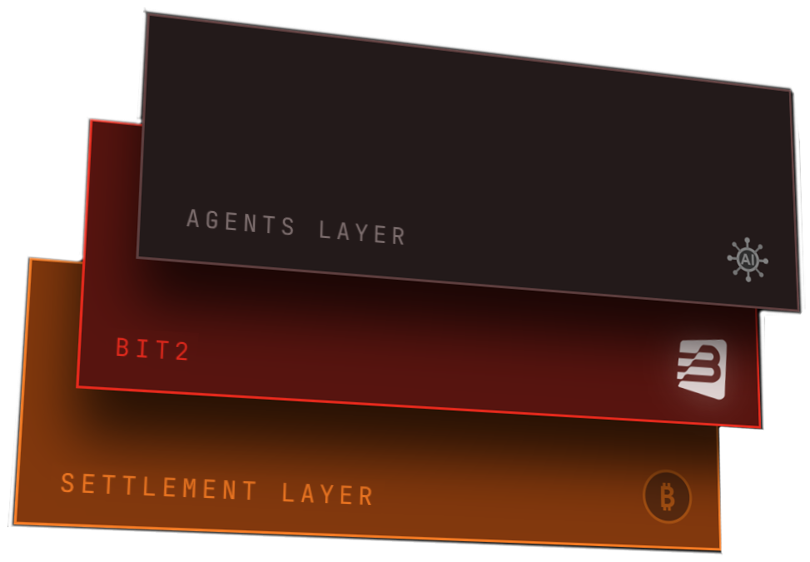
Bit2 operates in a similar manner. The Layer 1 blockchain functions as the regulated banking layer, while Bit2 functions as the private transaction layer. Compliance controls can be enforced when stablecoins enter or leave Bit2, without requiring surveillance of every transaction that occurs inside it.
However, Bit2 is significantly more powerful than physical cash. When a user wishes to move stablecoins back to the Layer 1 blockchain, they can provide cryptographic proofs demonstrating properties about their funds. For example, they can generate a proof that their assets have not interacted with blacklisted addresses, or a proof that the assets originated from approved sources.
This represents a fundamental improvement over both cash and traditional blockchain analytics. Instead of revealing an entire transaction history, users can prove specific compliance properties while keeping all unrelated financial information private.
In the long term, this approach may enable a new regulatory model based on cryptographic evidence rather than mass financial surveillance. Users disclose only what is necessary to establish compliance, while retaining privacy over all other activity.
Summary
Bit2 provides the ideal environment for agentic commerce using stablecoins:
- Native-like payment experience (no ERC-20 wrapping)
- Full privacy by default
- Stablecoin issuance and burning
- Issuer-controlled pausing of token transfers
- Issuer-selective freezing of wallets
- Issuer-managed address blocklists
- User-selective disclosure of transactions using zero-knowledge proofs
- ZK Proof of Reserves
- ZK Proof of Clean Assets (Proof of Innocence)
- ZK Proof of Source of Funds
Unlike traditional payment networks, Bit2 does not force a tradeoff between privacy and compliance. Users can preserve confidentiality while issuers retain the tools necessary to satisfy regulatory requirements.
Unlike public blockchains, commercial activity does not become permanently exposed to competitors, data brokers, or surveillance companies.
Unlike traditional financial systems, compliance can be demonstrated cryptographically instead of relying exclusively on trusted intermediaries.
Bit2 offers a stablecoin-native payment experience that combines privacy, scalability, regulatory compatibility, and cryptographic accountability.
As stablecoin regulation matures and agentic commerce expands, we believe that payment systems will increasingly require both privacy and compliance. Bit2 is designed to deliver both. If you are a stablecoin issuer, wallet provider, exchange, or infrastructure company interested in bringing compliant stablecoin payments to the next generation of autonomous agents, we invite you to collaborate with us and help shape the future of digital commerce.
Disclaimer: Regulatory frameworks for stablecoins and digital assets are evolving rapidly and differ across jurisdictions. Bit2 is designed to provide technical capabilities that may assist issuers and service providers in meeting compliance requirements, but regulatory obligations ultimately depend on the applicable laws, the deployment model, and the policies adopted by each participant. Nothing in this article should be construed as legal advice, and no representation is made that Bit2 will satisfy all current or future regulatory requirements in any jurisdiction.