
To Be Lazy Is To Be Fast: Low Latency in Client-Side Validation

In a world of agentic enterprises and agentic commerce, payment latency equals money. The faster a payment is confirmed, the faster a good or service can be delivered and the faster an agent can continue executing its planned task.
Today, credit card payment networks typically take between 1 and 7 seconds to approve a payment, with around 2 seconds being common. Since a typical Internet round-trip latency is below 200 milliseconds, a credit card payment completes roughly ten times slower than what the network itself would permit. At the same time, agents can process retrieved data in a fraction of a second, and their processing capabilities improve every year. This means that a data intelligence report that purchases data points using credit cards may be delivered five to ten times slower than necessary.
We want agent payments to be near-optimal, and the industry has converged on roughly 400 milliseconds as a target latency for agentic commerce.
When we designed Bit2, we architected the system and every one of its components to operate within these constraints. How do we achieve such low confirmation times?
Credible Precommitments
Payment authorization, approval, pre-confirmation, confirmation, capture, clearing, settlement, and finality are just some of the many terms used to describe the different stages of payment processing. The payments industry has developed a surprisingly rich vocabulary, and different systems—cards, ACH, RTGS, and cryptocurrencies—define these stages differently. Each stage provides a different level of assurance, but what matters most is that users and merchants are often willing to transact with only partial assurances when transaction values are low and risks are controlled.
Bit2 uses pre-confirmations to provide payment guarantees within approximately 400 milliseconds, making them ideal for low-value payments. Bit2 senders can obtain bonded precommitments from Timestamp Service Providers (TSPs) and transform these precommitments into off-chain pre-confirmations that can be delivered peer-to-peer to payment recipients.
The pre-confirmation is backed by a signed message from the TSP. If the payment timestamp is not committed on-chain during the next timestamping event, the receiver can use this message to claim a predefined failure compensation that compensates both the sender and the receiver. The sender can also trigger the compensation mechanism, which additionally reimburses the sender for any stamp credits consumed by the TSP. The entire process is automated through smart contracts and funded by slashing part of the TSP's security bond, thereby strengthening the credibility of TSP precommitments.
Unlike traditional payment authorization systems that depend on reputation, legal agreements, or operational procedures, Bit2 pre-confirmations are economically enforceable. The promise itself becomes a cryptographic asset that can be independently verified and enforced.
Advancing Bitcoin
into the
Agentic
Era
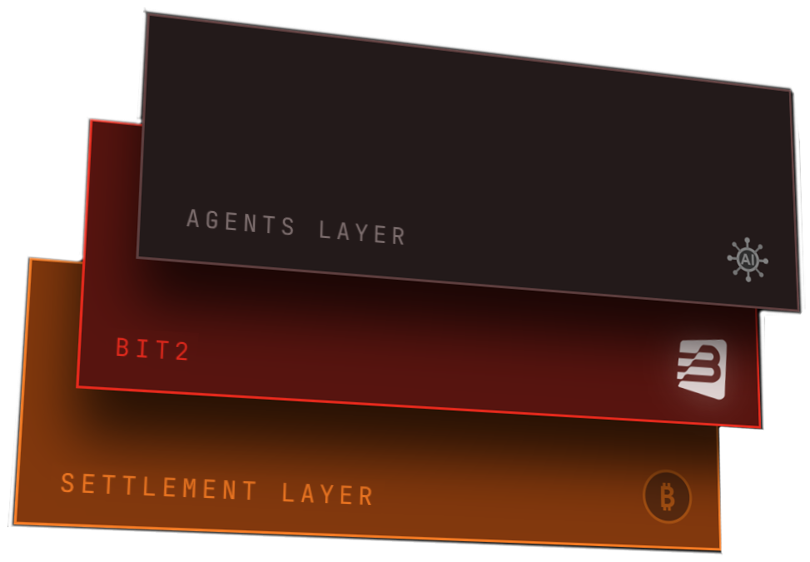
Bit2 is the economic layer for autonomous agents
Markets are operating continuously at scale, with agents emerging as independent economic
actors. This transformation requires infrastructure designed for autonomy — neutral, global, deterministic,
and enforceable by design.
Bit2 provides the infrastructure for sovereign agents to transact trustlessly on Bitcoin.
This level of pre-confirmation is stronger than what currently exists in most Ethereum L2s. Production rollups such as Optimism, Arbitrum, Base, and zkSync provide fast user experiences through centralized sequencers, but those sequencer acknowledgements are generally not backed by an on-chain bond that is automatically slashed if the promise is violated. The term "credible commitments" is often used in research literature to describe bonded pre-confirmations, yet very few production systems implement them today. Bit2 provides credible pre-confirmations out of the box.
The Zero-Knowledge Proving Stack
Bit2 uses recursive zero-knowledge proofs to enable confidential peer-to-peer value transfers with constant-size proofs. However, generating these proofs can require significant computational resources.
Bit2 employs several techniques to defer most of the heavy computation until after a payment has already been executed. This "lazy" approach to payment processing allows Bit2 to remain highly responsive while preserving all of its privacy, correctness, and succinctness guarantees.
Additionally, much of the proving burden—particularly what are often called exclusion proofs—is delegated to TSPs. TSPs periodically generate proofs for their clients showing how each timestamping event modified the client's timestamping state. As a result, knowledge of the latest client state is sufficient to verify that no timestamping event has been skipped.
The TSP itself applies the same philosophy of laziness: users receive immediate assurances, while expensive computations are performed later, outside the critical payment path.
This separation between the latency-critical path and the computation-intensive path is one of the key design principles behind Bit2. Users should never have to wait for cryptographic proving when making a payment.
The entire process is carefully orchestrated to provide immediate transaction feedback while the heavier computations occur behind the scenes.
High-Performance TSPs
Bit2 is designed to allow high-performance TSPs to process hundreds of thousands of requests per second. Our server architecture supports load balancing, parallel proving, pipelining, multithreading and sharding while avoiding resource contention in critical execution paths.
All these techniques work together to deliver fast pre-confirmations and next-block on-chain commitments.
At the same time, TSPs can manage congestion through optional Quality-of-Service (QoS) mechanisms for subscribed clients, ranging from timestamp bandwidth reservations to service prioritization.
Importantly, Bit2 does not require a single global TSP. Multiple providers can coexist and compete on latency, reliability, cost, and service quality, creating a market for timestamping services rather than a monopoly.
Best of all, the entire Bit2 protocol is open source. If you do not like our TSP service, you can operate your own TSP and provide whatever latency guarantees you desire.
Conclusion
The conventional wisdom in cryptography is that stronger guarantees require more computation. Bit2 embraces this reality—but only where it matters.
By moving expensive cryptographic operations away from the critical payment path, Bit2 allows users and agents to receive payment assurances in hundreds of milliseconds while still benefiting from strong privacy, zero-knowledge security, and cryptographic auditability.
In many systems, performance and security are competing objectives. In Bit2, they are reconciled through a simple principle: do the minimum amount of work necessary to keep the payment moving, and defer everything else.
In other words, Bit2 is fast because it is lazy.
As autonomous agents become the dominant participants in digital commerce, the systems that succeed will not be those with the strongest cryptography alone, but those that deliver strong cryptography at machine speed. Bit2 was designed from day one with that future in mind.