
Back to the Roots: Peer-to-Peer Payments

In the early days of Bitcoin, payments were envisioned as truly peer-to-peer. Users transacted directly using pseudonymous addresses, with a reasonable degree of privacy, and even had the option to send payments to specific IP addresses. Miners simply ordered transactions into blocks, without regard for their origin, purpose, or content—only fees and size mattered.
Over time, this model evolved. The industrialization of mining and the institutionalization of Bitcoin holdings introduced new dynamics: mempool policies, transaction filtering, and regulatory pressures. Transactions began to be interpreted and categorized. A transaction embedding arbitrary data might be treated differently from one opening a Lightning channel, even if both paid equivalent fees. In some cases, transactions could be deprioritized or excluded entirely based on their perceived purpose.
For users who rely on custodial services, this evolution is unavoidable. But for those who choose self-custody—whether for ideological, security, or usability reasons—such intermediaries become a liability. Users should not need to depend on third parties capable of inspecting, censoring, or selectively processing their transactions.
This tension becomes even more pronounced in the context of micropayments and agent-driven commerce. Traditional financial intermediaries are required to perform KYC and monitor transactions—requirements that may be tolerable for occasional high-value transfers. However, in a world of continuous, automated, low-value interactions between machines, such requirements are impractical. They introduce friction, delay, and cost that can render entire classes of applications economically infeasible.
Bit2 is designed to bring blockchain transactions back to their original peer-to-peer nature. Transactions are confidential by default, and while they still rely on on-chain commitments for security, the data committed to Bitcoin reveals no meaningful information about the underlying transaction. From the perspective of miners and observers, Bit2 activity appears as opaque commitments, decoupled from their economic meaning.
At its core, Bit2 allows users to issue commands that transfer ownership of tokens between wallets. These commands can be published directly on-chain through a mechanism called the Command Channel (CC), enabling fully peer-to-peer operation without any third party except miners. However, direct on-chain usage may be inefficient due to L1 costs. To address this, Bit2 introduces an off-chain transfer model combined with on-chain cryptographic timestamping.
Advancing Bitcoin
into the
Agentic
Era
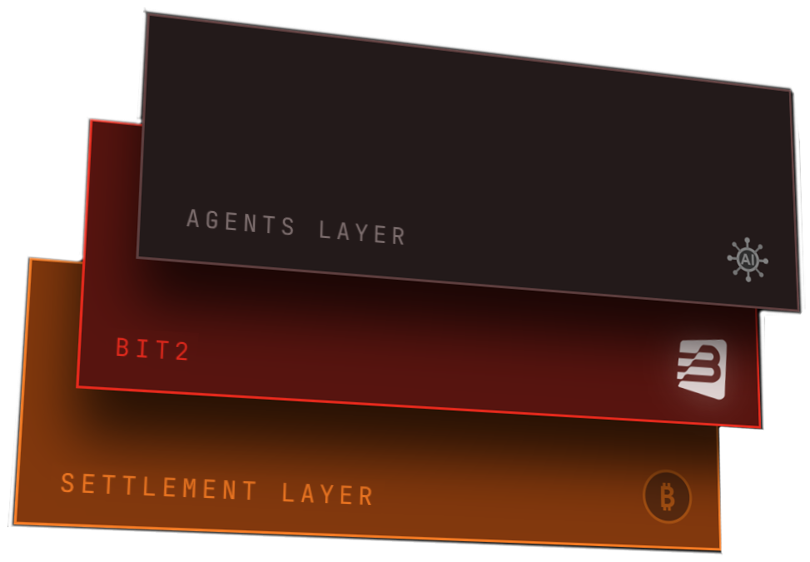
Bit2 is the economic layer for autonomous agents
Markets are operating continuously at scale, with agents emerging as independent economic
actors. This transformation requires infrastructure designed for autonomy — neutral, global, deterministic,
and enforceable by design.
Bit2 provides the infrastructure for sovereign agents to transact trustlessly on Bitcoin.
Users can issue commands off-chain and request a Timestamp Service Provider (TSP) to timestamp a hash of those commands. While timestamping services already exist—such as those offered by companies like GlobalSign, Sectigo, and DigiCert—Bit2 requires stronger guarantees than standard RFC 3161 timestamping.
In Bit2, each timestamp must include a per-user sequential counter, or equivalently, a commitment to the latest link in a hash chain of the user’s timestamped data.This ensures that users can prove that all issued commands have been timestamped without omission. In contrast, RFC 3161 only requires a global sequence number that is not tied to any specific user and may not be strictly sequential. Moreover, RFC 3161 explicitly avoids including requester identity, whereas Bit2 requires per-user identification to enforce ordering guarantees.
A Bit2 TSP aggregates many user requests, constructs a Merkle tree of their hashes, and commits the root to the blockchain in a single transaction. This provides a shared timestamp for all included commands, derived from the block height and time. Similar to systems like OpenTimestamps, this allows efficient batching while preserving verifiability.
Importantly, only the users who submitted data can later decode the commitment and extract proofs about the ordering of their commands. This ordering enables users to prove, locally and in zero-knowledge, the validity of their wallet state and transaction history. The receiver of a payment only receives a proof of correctness—not the underlying transaction data—preserving confidentiality throughout the process.
Timestamp Service Providers in Bit2 are optional and non-custodial. They do not hold user funds, cannot interpret the data they process, and may or may not charge for their services. Multiple TSPs can coexist and compete on performance and reliability.
Crucially:
- TSPs are not authoritative: they cannot forge valid histories, only deny service.
- The blockchain remains the ultimate source of truth.
- Users can freely switch providers or operate their own.
- TSPs do not store meaningful user data; all inputs are nonced and indistinguishable from random bytes.
Some TSPs may offer pre-commitments: signed promises that certain data will be included in future commitments. These can be used to enforce penalties if commitments are not honored, and also enable pre-confirmations—cryptographic assurances that a transaction will be settled. This is particularly useful for low-value, latency-sensitive payments.
Conclusion
Bit2 redefines what it means for a payment system to be peer-to-peer. By separating transaction validity from data visibility, and by minimizing reliance on intermediaries, it restores the original vision of blockchain-based payments—while adapting it to the realities of modern, automated economies.
In a world increasingly driven by agents and continuous micro-transactions, payment systems must be fast, private, and reliable without introducing regulatory or operational bottlenecks. Bit2 achieves this by combining client-side validation, cryptographic timestamping, and minimal on-chain commitments into a coherent architecture.
The result is not just a more efficient payment network, but a fundamentally more neutral and programmable financial layer—one where transactions are validated by cryptography, not interpreted by intermediaries.