
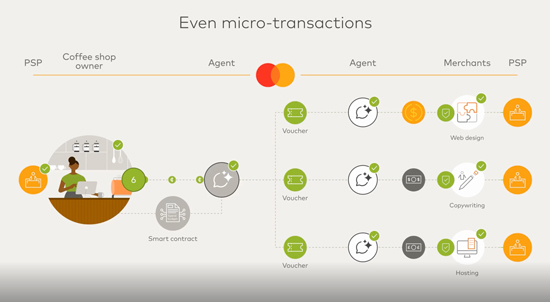
Mastercard launches Agent Pay for Machines, targeting sub-cent, high-frequency transactions
Mastercard extended its Agent Pay program with a version built specifically for machine-to-machine payments: fractions of a cent, executed continuously and without human review. The service supports settlement across cards, accounts, and stablecoins, positioning Mastercard alongside Visa and Stripe in the race to own the rails beneath agentic commerce — though it does little to resolve who is liable when an agent's payment goes wrong.
Number of the Month
The number of companies — including Visa, Stripe, Mastercard, BlackRock, and Coinbase — backing Open USD, a new consortium-governed stablecoin announced June 30, 2026 (CoinDesk, American Banker).
It's a striking response to a concern this newsletter flagged last month: nearly all agent payments currently settle in a single stablecoin, USDC. Open USD doesn't resolve that concentration risk on its own, but it signals that the industry's largest players see single-issuer dependency as a problem worth organizing 140 companies to solve. Circle's stock fell more than 17% the day of the announcement — a reminder that this is being read as a competitive threat, not just an infrastructure experiment.
Perspectives
Three pieces of Bit2 research published this month circle one question: how much can a design compromise on its way to market before it stops being that design?
The premise itself is uncompromising. Agentic commerce, as Bit2's principles define it, requires payments that are cheap, scalable, deterministic, irreversible, private, and policy-restricted, all at once, over a decentralized network, properties that usually pull against each other. The principles exist to reject architectures that trade one away for another.
The deployment path is less rigid. Building on an EVM-compatible Bitcoin layer first, instead of natively on Bitcoin, reads like a concession: less decentralization for faster iteration. It isn't framed that way here: staying Bitcoin-aligned doesn't require being Bitcoin-native on day one, only keeping a credible path back. Rootstock offers that path through Union, a bridge whose trust-minimization comes from BitVMX, not an operator's goodwill.
The same tension shows up in how Bit2 treats stablecoins. Compliance and privacy are usually a dial — more of one costs the other. Bit2's answer resembles the relationship between banks and physical cash: compliance enforced at the edges, where value enters and exits, not through surveillance of every transfer between. Selective disclosure, proof of reserves, proof of clean assets each let a user prove exactly what a regulator needs, nothing more.
None of this treats the principles as fixed points, but as what determines which trade-offs are allowed. A deployment chain can change, a compliance requirement can change. What can't, without becoming a different protocol, is what happens to a user's funds when every surrounding service fails at once.
Lower Latency
A space to slow down, read deeper, and sit with ideas worth more than a scroll.
Self-custody is usually treated as binary: you hold the keys, or you don't. This piece argues it's actually three separate guarantees: the ability to keep transacting without anyone's cooperation, the ability to exit to the base layer even if every service provider turns hostile, and the ability to do both when everyone tries to exit at once.
It's not hypothetical: Arbitrum's Security Council has already frozen millions in user funds, and a June 2026 sequencer outage on Base blocked all withdrawals for two hours. The piece walks through how rollups, Ark, and Lightning each hold up, or don't, under exactly that last, hardest condition.
fairgate.io/blog
˙✦
Bit2: You Control Your Funds — No One Else