

How Collateral Influences Payments Cost in Agentic Payments
As autonomous systems begin to transact at scale, payment infrastructure must support continuous, high-frequency exchanges without human intervention. From data access to compute and energy, these agent-driven interactions demand systems that can reliably process large volumes of small transactions in real time.
However, beyond throughput and latency, a less visible but fundamental constraint emerges: how much capital must be locked as collateral to make these systems function. In a world of high-frequency, machine-driven commerce, the cost of immobilizing capital becomes a primary determinant of long-term transaction fees and economic efficiency.
Transaction cost is often associated with network fees, but in many payment systems the dominant cost is indirect: the cost of capital tied up as collateral. Whenever funds must be pre-committed—whether in payment channels, liquidity pools, or shared UTXOs—those funds cannot be deployed elsewhere. This creates an opportunity cost that scales with both the amount of capital locked and prevailing market yields.
Advancing Bitcoin
into the
Agentic
Era
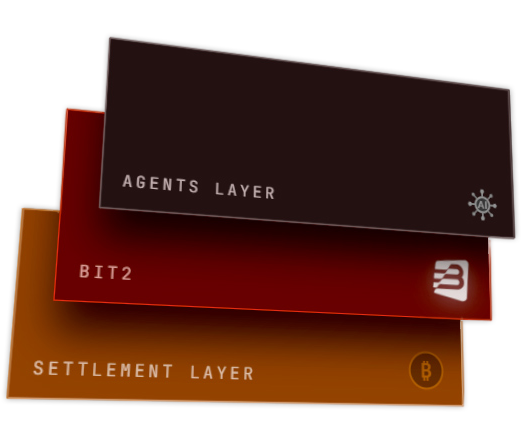
Bit2 is the economic layer for autonomous agents
Markets are operating continuously at scale, with agents emerging as independent economic
actors. This transformation requires infrastructure designed for autonomy — neutral, global, deterministic,
and enforceable by design.
Bit2 provides the infrastructure for sovereign agents to transact trustlessly on Bitcoin.
In efficient markets, capital seeks the highest risk-adjusted return. Therefore, any system that requires locked collateral must offer a comparable yield to attract liquidity providers. This yield can only come from transaction fees or subsidies. Over time, as subsidies disappear, fees must rise to compensate liquidity providers for the capital they immobilize. As payment volume grows, the system must lock proportionally more capital to sustain throughput, further increasing the aggregate cost basis. This creates a structural link between throughput, collateralization, and user fees, making transaction costs inherently sensitive to interest rates and capital demand.
If Bit2 does not depend on maintaining liquidity inside channels or shared pools, no capital must remain locked as routing or settlement collateral. The only scarce resource consumed is Bitcoin blockspace for occasional commitments, so the marginal cost of transactions is primarily data availability and verification—rather than the opportunity cost of locked funds. Time-stamping servers may optionally post security bonds to provide fast time-stamp assurances, allowing them to economically guarantee that a blob of data will be time-stamped in a future commitment. However, these bonds are not required for the basic operation of the protocol. In addition, pegnatories (BitVMX committee members) may lock security deposits to ensure honest behavior in dispute resolution. Importantly, these deposits are not proportional to the total value of funds bridged into the system; instead, they are sized relative to the cost of executing disputes and enforcing correctness. As a result, Bit2 does not require proportional collateralization of the payment volume in order to operate securely.
Similarly, Base and other optimistic rollups—including proposed Bitcoin rollups—require security bonds from the parties that submit or challenge bridge withdrawals, so that incorrect withdrawal proofs can be economically penalized during the dispute period.
In contrast, Lightning and Ark rely on pre-funded liquidity to guarantee instant settlement. Lightning locks coins in payment channels so that intermediate nodes can forward payments without trusting each other, while Ark locks funds in shared UTXOs or virtual-UTXO pools managed by service providers. In both cases, the locked funds act as collateral ensuring that payments can be honored even if participants disappear or misbehave. However, capital that is locked cannot be used elsewhere, creating an opportunity cost proportional to interest rates and payment volume. Over time, routing nodes or Ark providers must recover this cost through fees. Therefore, even if early deployments subsidize fees to bootstrap adoption, the long-term transaction price inevitably reflects the capital cost of maintaining sufficient collateral to support the network’s payment throughput.
Conclusion
In agentic payment systems, transaction fees are not only a function of computation or bandwidth—they are fundamentally shaped by capital efficiency. Systems that depend on proportional collateralization embed an unavoidable economic cost: locked capital must be compensated, and that compensation ultimately comes from users.
Bit2 takes a different approach by decoupling payment throughput from collateral requirements. By eliminating the need for pre-funded liquidity and limiting security deposits to dispute-related costs rather than total value secured, Bit2 avoids the structural fee pressure imposed by capital lock-up. This allows transaction costs to scale with actual resource usage—data availability and verification—rather than with global liquidity requirements.
As machine-driven commerce grows, this distinction becomes critical. Systems that minimize collateral dependencies will not only scale more efficiently, but will also offer more predictable and sustainable pricing for the high-frequency, low-margin transactions that define agentic economies.
Compared with payment channel networks (PCNs) such as the Lightning Network, client-side validation offers several advantages. It achieves comparable or higher throughput without requiring liquidity to be locked in channels, simplifies the protocol design by reducing the number of interacting parties, and provides stronger confidentiality since transaction histories can be compressed into succinct cryptographic proofs.
Compared with rollups, the architecture is fundamentally different. Rollups rely on a centralized or semi-centralized sequencer that orders transactions and periodically publishes batches of transaction data (or validity proofs) to the base layer. This design makes the system dependent on sequencer availability and on significant L1 data bandwidth. In practice, rollups scale by consuming increasing amounts of base-layer data availability, making their throughput directly tied to L1 capacity and cost.
Bit2, by contrast, avoids publishing per-transaction data to the base layer. Instead, it anchors only compact commitments that summarize many transactions, achieving a dramatically lower L1 footprint per transaction. This allows Bit2 to scale without competing for scarce base-layer bandwidth, making it inherently more efficient and less sensitive to L1 congestion or fee volatility.
While Bit2 also includes a time-stamping service role, this function is not unique or privileged: multiple independent time-stamping servers can coexist and compete to offer better quality of service and lower fees, and users can freely register with or leave any time-stamping service. In contrast, most existing rollups rely on a single active sequencer, which introduces a potential single point of failure and censorship risk. Bit2 avoids this structural dependency because time-stamping servers do not control transaction validity or ordering.
Another important distinction lies in system failure modes. Payment channel networks degrade when liquidity becomes imbalanced or routing paths fail, leading to increasing transaction failures. Rollups depend on sequencer availability and honest data publication; if the sequencer is offline or adversarial, users may face delays, censorship, or costly exits to the base layer. Bit2, on the other hand, degrades gracefully. Even if time-stamping services become unavailable or adversarial, users retain full control over their funds and can fall back to base-layer mechanisms. Because no single party controls transaction validity or ordering, the system remains operational under a wide range of adverse conditions.
Conclusion
Client-side validation redefines what a payment system can be in a world of autonomous agents. By moving verification to the edges and minimizing reliance on shared infrastructure, Bit2 achieves what legacy architectures struggle to deliver simultaneously: deterministic execution, massive scalability, strong privacy, and resilience against both technical and regulatory failure modes. Payments become lightweight, verifiable state transitions rather than routed negotiations or sequenced batches.
Bit2 stands out because it aligns the architecture of money with the needs of machine economies. It removes liquidity bottlenecks, eliminates dependence on centralized coordinators, and compresses global state into minimal on-chain commitments without sacrificing security. The result is a system where transactions behave like reliable API calls—predictable, fast, and independent of network conditions or intermediary cooperation. For agentic commerce, where failure rates, latency, and privacy leaks directly translate into economic inefficiencies, this is not just an improvement—it is a necessary evolution.