
Confidentiality in Commercial Agentic Transactions
The next generation of the internet will be powered not only by humans, but by autonomous agents and machines continuously exchanging value. Software agents purchasing compute resources, IoT devices paying for bandwidth, robots buying energy, and AI services paying for data will require payment systems capable of executing millions of small transactions reliably and instantly.
Traditional payment networks were not designed for this environment. Most systems suffer from one or more structural limitations: capital must be locked to route payments, transaction data must be published to the base chain, routing failures are common, or centralized operators become regulatory choke points. While these designs may work for human commerce, they create serious constraints for machine-to-machine (agentic) economies, where payments must behave more like deterministic API calls than like probabilistic financial operations.
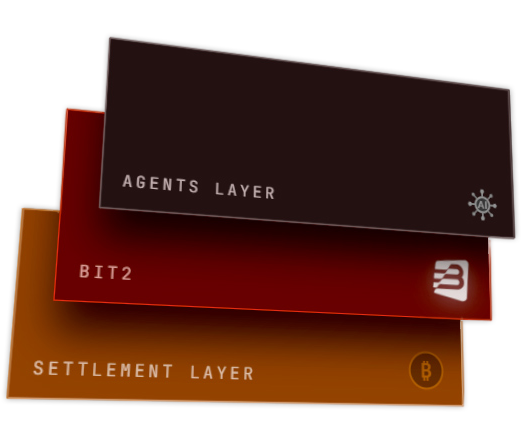
Bit2 is a new Layer-2 payment architecture based on client-side validation and cryptographic state compression. Instead of relying on liquidity routing or centralized sequencers, Bit2 allows users to exchange ownership of coins directly while anchoring minimal commitments to the base layer. This approach dramatically reduces reliance on base-layer bandwidth while enabling extremely high throughput, deterministic payment success, and strong confidentiality.
In client-side-validated systems such as Bit2, coin ownership evolves through cryptographic state transitions that the receiver validates locally, using commitments anchored periodically to Bitcoin. In this model, the sender transfers the right to spend specific coins, and the receiver verifies that the transfer is valid and not double-spent according to the history presented. Bitcoin is used only to leave a private cryptographic trace of all outgoing transfers produced by an account, binding them together in a log chain. This log chain ensures that a user cannot prove the existence of a particular outgoing transfer without also considering all previous transfers that were committed before it inside the proof. As a result, selective processing of transaction history becomes impossible, preventing equivocation while still preserving strong privacy.
A key property of this architecture is deterministic payment success. In traditional payment channel networks, such as the Lightning Network, payments may fail due to insufficient liquidity, routing fragmentation, or network topology constraints, and success probability often decreases as the payment amount increases. In contrast, Bit2 transactions succeed deterministically once accepted by the receiver: there is no routing process, no dependency on third-party liquidity, and no probabilistic execution. This makes payments behave like reliable API calls, a critical requirement for agentic systems that depend on predictable outcomes.
Advancing Bitcoin
into the
Agentic
Era
Bit2 is the economic layer for autonomous agents
Markets are operating continuously at scale, with agents emerging as independent economic
actors. This transformation requires infrastructure designed for autonomy — neutral, global, deterministic,
and enforceable by design.
Bit2 provides the infrastructure for sovereign agents to transact trustlessly on Bitcoin.
Compared with payment channel networks (PCNs) such as the Lightning Network, client-side validation offers several advantages. It achieves comparable or higher throughput without requiring liquidity to be locked in channels, simplifies the protocol design by reducing the number of interacting parties, and provides stronger confidentiality since transaction histories can be compressed into succinct cryptographic proofs.
Compared with rollups, the architecture is fundamentally different. Rollups rely on a centralized or semi-centralized sequencer that orders transactions and periodically publishes batches of transaction data (or validity proofs) to the base layer. This design makes the system dependent on sequencer availability and on significant L1 data bandwidth. In practice, rollups scale by consuming increasing amounts of base-layer data availability, making their throughput directly tied to L1 capacity and cost.
Bit2, by contrast, avoids publishing per-transaction data to the base layer. Instead, it anchors only compact commitments that summarize many transactions, achieving a dramatically lower L1 footprint per transaction. This allows Bit2 to scale without competing for scarce base-layer bandwidth, making it inherently more efficient and less sensitive to L1 congestion or fee volatility.
While Bit2 also includes a time-stamping service role, this function is not unique or privileged: multiple independent time-stamping servers can coexist and compete to offer better quality of service and lower fees, and users can freely register with or leave any time-stamping service. In contrast, most existing rollups rely on a single active sequencer, which introduces a potential single point of failure and censorship risk. Bit2 avoids this structural dependency because time-stamping servers do not control transaction validity or ordering.
Another important distinction lies in system failure modes. Payment channel networks degrade when liquidity becomes imbalanced or routing paths fail, leading to increasing transaction failures. Rollups depend on sequencer availability and honest data publication; if the sequencer is offline or adversarial, users may face delays, censorship, or costly exits to the base layer. Bit2, on the other hand, degrades gracefully. Even if time-stamping services become unavailable or adversarial, users retain full control over their funds and can fall back to base-layer mechanisms. Because no single party controls transaction validity or ordering, the system remains operational under a wide range of adverse conditions.
Conclusion
Client-side validation redefines what a payment system can be in a world of autonomous agents. By moving verification to the edges and minimizing reliance on shared infrastructure, Bit2 achieves what legacy architectures struggle to deliver simultaneously: deterministic execution, massive scalability, strong privacy, and resilience against both technical and regulatory failure modes. Payments become lightweight, verifiable state transitions rather than routed negotiations or sequenced batches.
Bit2 stands out because it aligns the architecture of money with the needs of machine economies. It removes liquidity bottlenecks, eliminates dependence on centralized coordinators, and compresses global state into minimal on-chain commitments without sacrificing security. The result is a system where transactions behave like reliable API calls—predictable, fast, and independent of network conditions or intermediary cooperation. For agentic commerce, where failure rates, latency, and privacy leaks directly translate into economic inefficiencies, this is not just an improvement—it is a necessary evolution.