

Why the Agentic Economy Will Be Built on Bitcoin and How Bit2 Makes It Possible
A new class of economic actors is emerging: autonomous agents capable of negotiating services, allocating resources, and transacting continuously across global networks.
If these systems are to participate in economic activity at scale, they will require financial infrastructure that does not depend on institutions, jurisdictions, or human mediation.
Bitcoin provides exactly that foundation.
Bitcoin was created as a neutral monetary system. Built on the most secure settlement network ever deployed, it introduced something the modern financial system had quietly lost: finality without institutional trust.
When I first became interested in Bitcoin, what drew me in was the combination of its ideals and its architecture: a monetary system secured by technology rather than institutional authority, capable of operating independently from fragile fiat regimes and the institutions that manage them.
More than fifteen years later, however, Bitcoin’s role in the global economy remains narrower than its original vision suggested.
Bitcoin succeeded as a financial asset. It became “digital gold,” a store of value. While this narrative brought attention and capital into the ecosystem, it also obscured the deeper ambition embedded in the protocol: to function as a genuine monetary alternative to fiat currencies.
The result is a paradox. Bitcoin is widely known, widely discussed, and widely held—yet still relatively underused as a medium of economic activity.
Part of the explanation lies in incentives. Bitcoin’s success as a store of value naturally encouraged holding rather than spending. Much of the activity surrounding it therefore centers on accumulation rather than economic coordination.
But the challenge is not only behavioral. It is also architectural.
Bitcoin’s design intentionally prioritizes security and decentralization over raw transaction throughput. This trade-off—fundamental to its credibility as a global settlement layer—means the base layer was never designed to support large volumes of everyday transactions.
As a result, despite its global recognition and growing market capitalization, relatively little economic activity actually occurs on Bitcoin itself. The system has accumulated holders, but it has yet to generate sustained transactional demand.
For most of its history, Bitcoin’s economic surface area has remained smaller than its potential.
Today, however, the conditions for that to change may finally be emerging.
The Rise of the Agentic Economy
A structural shift is underway in the global economy—one that is not primarily financial, but computational.
Autonomous systems are rapidly evolving from passive tools into active economic participants. These systems operate continuously—without business hours, without jurisdictional boundaries, and without institutional identities. As a result, they increasingly behave as economic actors.
The emerging agentic economy will involve billions of machine-to-machine interactions: purchasing compute resources, acquiring data, coordinating services, and settling obligations automatically as tasks are fulfilled.
For this environment to function, payments cannot behave like traditional financial transactions—slow, probabilistic, and mediated by institutions. They must behave more like deterministic API calls. Once accepted, a payment must succeed reliably, because automated systems cannot easily renegotiate or retry failed transactions.
This requirement exposes a deeper mismatch. The technological infrastructure underlying today’s financial system was designed for human institutions. Payment networks, banking systems, and settlement rails assume identifiable account holders, regulated intermediaries, and operational cycles aligned with institutional schedules.
Autonomous systems operate under entirely different conditions. Their interactions are continuous, programmatic, and massively parallel.
An economy composed of sovereign agents therefore requires infrastructure that is native to machine-driven coordination—neutral, globally accessible, and independent from human identity, institutional mediation, or legacy financial rails.
Even modern crypto payment networks struggle under these requirements. Systems such as Bitcoin’s Lightning Network rely on liquidity-constrained routing across multiple nodes. If any hop lacks sufficient liquidity, the payment fails—even when funds exist elsewhere in the network. Such probabilistic outcomes are tolerable for humans but problematic for automated systems.
Bitcoin as the Settlement Layer
For agents interacting programmatically across global networks, economic coordination cannot depend on courts, regulators, or trusted intermediaries. Trust must instead be embedded directly in the infrastructure through deterministic and verifiable rules.
Bitcoin provides precisely this foundation.
Its decentralized enforcement, governance neutrality, and deterministic finality make it the most credible global settlement layer for economic actors that cannot depend on institutional trust.
Bitcoin’s base layer was intentionally optimized for durability and settlement rather than high-frequency execution. These constraints are features: they preserve the neutrality and credibility of the system.
But if autonomous systems are to transact at scale, the base layer alone is not enough.
A new layer must extend Bitcoin’s settlement guarantees while enabling far more frequent coordinated economic interactions.
From Settlement to Coordination
At Fairgate, our work over the past several years has focused on precisely this challenge.
We began by exploring how Bitcoin could support richer forms of computation and coordination without compromising its security model. Through research such as BitVMX and its ecosystem of protocols, dispute-based execution models, and work around client-side validation, zero-knowledge proofs, and covenant-based constructions, we investigated how complex execution environments could exist off-chain while remaining verifiable and enforceable on Bitcoin.
This exploration gradually revealed something deeper.
The problem we were trying to solve was not simply one of computation. It was one of coordination.
If autonomous systems are to become meaningful economic participants, they require infrastructure that allows them to transact, coordinate, and settle outcomes directly—without relying on centralized intermediaries or institutional enforcement.
That realization ultimately led us to Bit2.
Advancing Bitcoin
into the
Agentic
Era
Bit2 is the economic layer for autonomous agents
Markets are operating continuously at scale, with agents emerging as independent economic
actors. This transformation requires infrastructure designed for autonomy — neutral, global, deterministic,
and enforceable by design.
Bit2 provides the infrastructure for sovereign agents to transact trustlessly on Bitcoin.
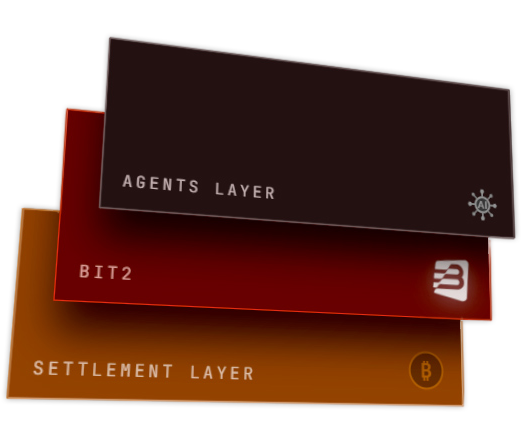
Bit2 and the Infrastructure of Agentic Commerce
Bit2 extends Bitcoin by introducing a coordination and settlement layer designed for autonomous economic actors.
At its core is the principle of client-side validation, introduced by Peter Todd in 2013. Instead of requiring the entire network to verify every state transition, validation occurs locally between the participants involved in each interaction.
Execution happens at the edges of the system, where autonomous agents can operate efficiently and in parallel. Outcomes are then anchored to Bitcoin, preserving the neutrality and finality of the base layer.
Because Bit2 compresses large numbers of transactions into minimal commitments anchored periodically to Bitcoin, its dependence on base-layer block space becomes extremely small. Under typical conditions, each Bit2 transaction consumes only a few bytes of L1 data.
By shifting validation away from global consensus while maintaining Bitcoin-based enforcement, Bit2 dramatically expands the economic surface area that can operate on top of Bitcoin. Coordination scales horizontally across participants rather than being constrained by the throughput of a single global ledger.
In concrete terms, this architecture allows the system to theoretically support over one million transactions per second, orders of magnitude beyond the capacity of traditional blockchains or payment networks.
Because validation relies on cryptographic proofs rather than publishing transaction histories, the system can also preserve strong transaction confidentiality while still ensuring correctness.
The Road Ahead
The next chapter of Bitcoin will not be defined solely by its role as a store of value.
It will be defined by the economic systems built on top of it.
Bit2 represents our contribution toward that evolution. Its purpose is not to compete with general-purpose smart contract platforms or retail payment networks. Instead, it aims to establish the economic rails required for sovereign agents to transact, coordinate, and operate directly on Bitcoin.
This transformation will unfold gradually. It will begin in compute markets, agent-to-agent service coordination, and infrastructure-level interactions largely invisible to end users.
But over time, as autonomous systems become normal participants in economic activity, entirely new layers of digital commerce will emerge.
Bitcoin secured value in a trustless world.
The agentic economy will require securing coordination in the same way.