




Computing on Bitcoin #73
January 23, 2026 - Week 04
Welcome to a new edition of Computing on Bitcoin News.
Each week, we bring you the research, prototypes, and insights moving the ecosystem forward.
Let’s dive into what’s new this week.
Sergio Lerner traces the history of Bitcoin sidechains, from early scaling ideas to Rootstock and BitVMX, discussing past trade-offs and a trust-minimized future for bridges in an in-depth interview with Isabel Foxen Duke.
Bitcoin is entering the banking system: BitVM, Metallicus and the future of cryptocurrencies.
youtube.com/@BitcoinRails
Lesser known is Lerner’s recent contributions to the development of BitVM—through his team’s Alliance-independent implementation, BitVMX.
In addition to their unique BitVM implementation (optimizing for different tradeoffs compared to Robin Linus BitVM Alliance), the BitVMX team is quietly operating as the “fixer” service provider to many of the most interesting BitVM rollups set to launch in 2026.
A post by Robin Linus announces the launch of ideal by the creators of BitVM, introducing Argo, a new garbling scheme led by Liam Eagen and Ying Tong Lai that aims to reduce off-chain computation costs by ~1000×.
BitVM2 made Bitcoin bridges possible. BitVM3 cut on-chain costs by 1,000x with garbled circuits. Now @liameagen's breakthrough scheme, Argo, cuts off-chain costs by another 1,000x—making off-chain computation on Bitcoin truly efficient and practical.
— Robin Linus (@robin_linus) January 19, 2026
👷🏻♂️👷🏻♂️👷🏻♂️ https://t.co/8WRAzJ6AbV
eprint.iacr.org
🔗
Argo MAC Garbling with Elliptic Curve MACs
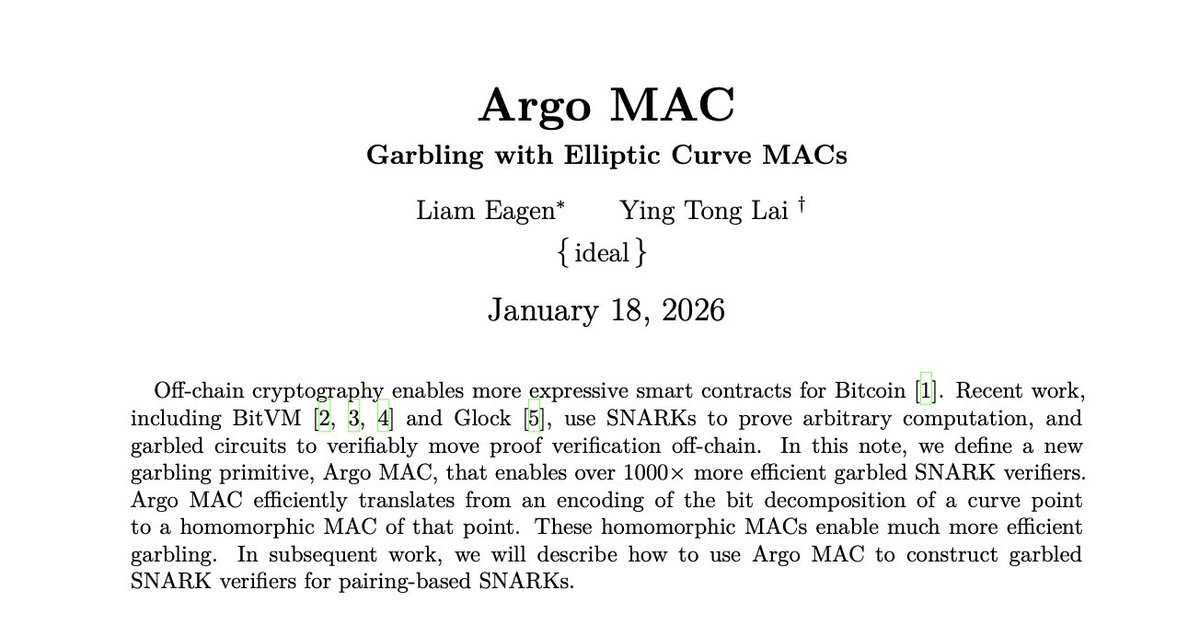
Argo MAC efficiently translates from an encoding of the bit decomposition of a curve point to a homomorphic MAC of that point. These homomorphic MACs enable much more efficient garbling.In subsequent work, we will describe how to use Argo MAC to construct garbled SNARK verifiers for pairing-based SNARKs.
Boundless has introduced cross-chain ZK proof verification from Ethereum and Base to Bitcoin, using BitVM to bring verifiable off-chain computation into production. This launch marks a turning point for Bitcoin as a settlement and verification layer, unlocking a new class of cross-chain ZK workflows with minimal trust assumptions. The system is supported by early ecosystem partners like Citrea, and aims to expand to additional chains soon.
Bitcoin was built to settle transactions. Now Boundless settles zero-knowledge proofs on it too.
— Boundless (@boundless_xyz) January 22, 2026
Request proofs from @Base and @Ethereum, settle them on Bitcoin.
The world's largest proof network is bringing programmability to BTC. pic.twitter.com/D4DLoodwMD
A new research paper introduces BABE, a protocol that makes verifying succinct proofs on Bitcoin up to 1000× cheaper off-chain, preserving BitVM3’s on-chain savings while dramatically reducing storage and setup costs.
eprint.iacr.org
🔗
BABE: Verifying Proofs on Bitcoin Made 1000x Cheaper
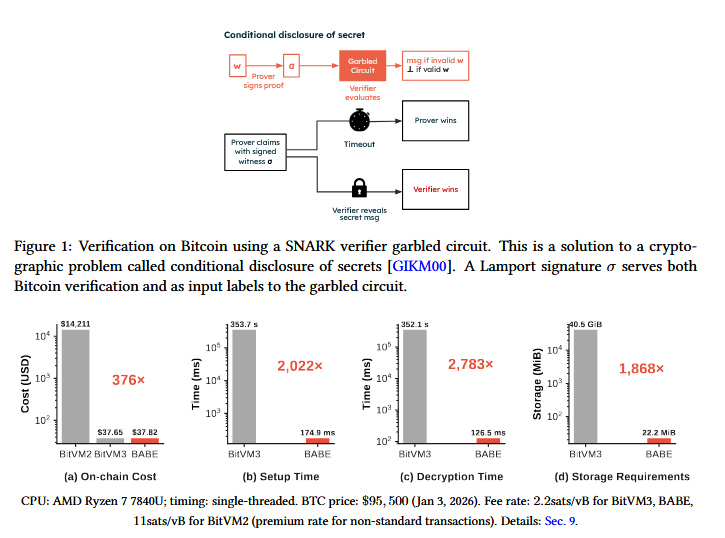
This paper introduces BABE, a new proof verification protocol on Bitcoin, which preserves BitVM3’s savings of on-chain costs but reduces its off-chain storage and setup costs by three orders-of-magnitude. BABE uses a witness encryption scheme for linear pairing relations [GKPW24] to verify Groth16 proofs. Since Groth16 verification involves non-linear pairings, this witness encryption scheme is augmented with a secure two-party computation protocol implemented using a very efficient garbled circuit for scalar multiplication on elliptic curves.
Fairgate shared the launch of a centralized Resource Hub consolidating talks, slides, videos, and technical content on BitVMX and Fairgate’s research for easier access.
Looking for everything we’ve shared on BitVMX and our work at Fairgate?https://t.co/CjYiP4Ccrl
— Fairgate (@FairGateLabs) January 19, 2026
Our new Resources Hub brings together talks, slides, videos, and technical content, all in one place.
Find it here!👇
bitcoin++ published a talk from its 2025 Berlin event featuring Sergio Lerner on building secure, watchtower-efficient Bitcoin payment channels using BitVMX.
Building Secure and Watchtower efficient Bitcoin Payment Channels with BitVMX - Sergio Lerner
youtube.com/@btcplusplus
bitcoin++ 2025 lightning edition
Hemi outlines a Bitcoin-native path for BTCFi using Hemi Tunnels, combining Proof-of-Proof anchoring, an EVM-compatible VM, and BitVM-style trust-minimized flows to activate BTC in DeFi without wrapped assets or custodians.
hemi.xyz/blog
🔗
Why the Future of BTCFi Requires Hemi Tunnels
Institutions today hold over 2.6 million BTC ($260B+), yet less than 0.8% of this capital participates in DeFi. Why? Because legacy activation methods, like Wrapped BTC (WBTC, tBTC, cbBTC), introduce:
· Custodial risk from centralized or federated minting schemes
· Redemption delays and friction during volatility
· No enforcement of Bitcoin consensus, leaving security dependent on third parties
Thanks for following along with this week’s edition of Computing on Bitcoin News.
If you find these updates valuable, don’t forget to share them with your peers and help expand the conversation around Bitcoin's programmable future.Until next time!
The Fairgate Team